
New Cyrillic transliteration tool
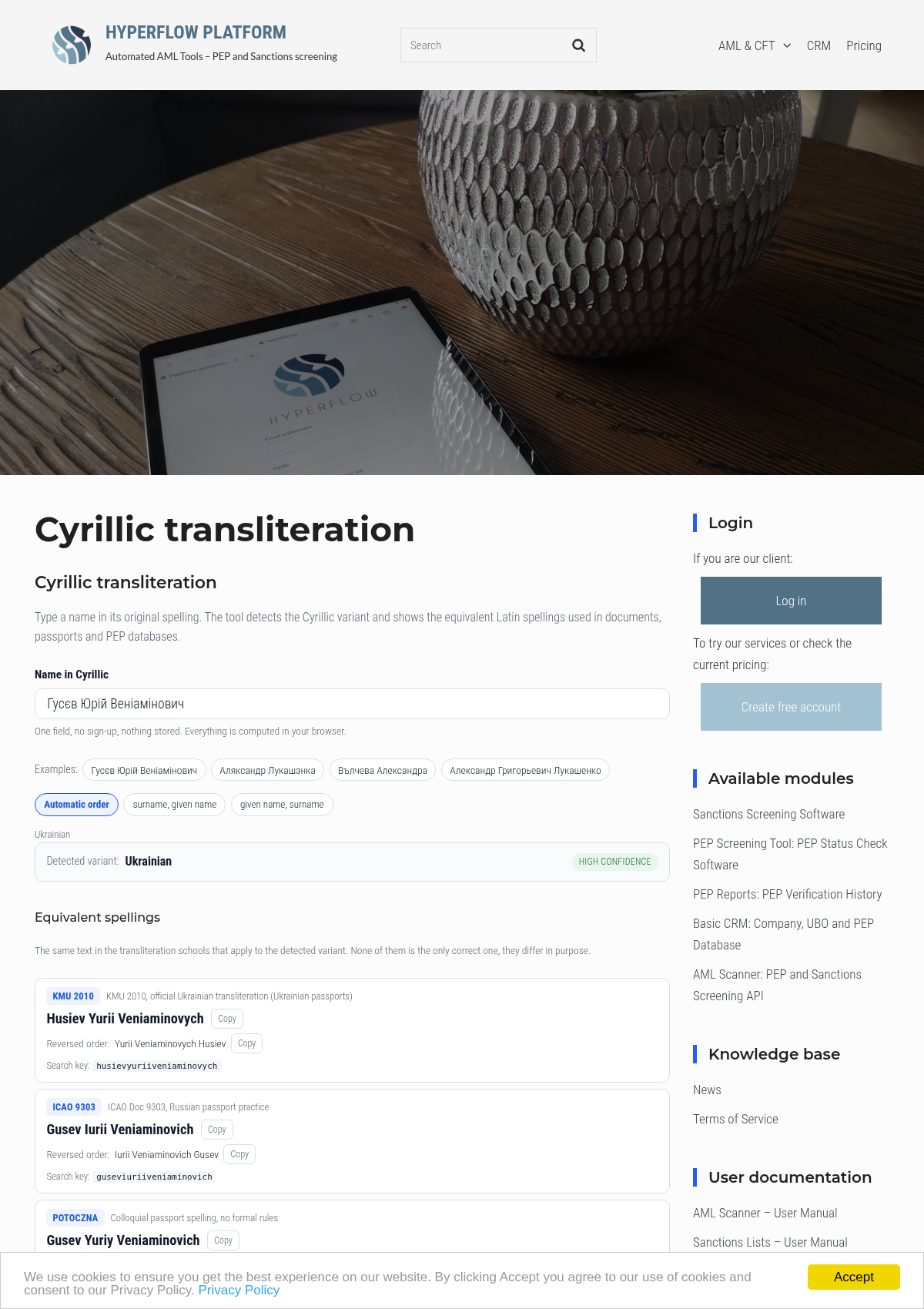
We are releasing a helper tool for Cyrillic transliteration. Type a name in its original spelling and the tool identifies the language variant and shows the equivalent Latin spellings.
In PEP and sanctions screening the same person can appear under several spellings. The passport form differs from the company register, which differs again from a press source. One letter is enough to split records and make a search stop matching.
The tool detects the Ukrainian, Russian, Belarusian and Bulgarian variant of Cyrillic, then shows what sits behind a given spelling: KMU 2010 for Ukrainian, ICAO 9303 for Russian, the colloquial form, Belarusian state practice, the Bulgarian Streamlined System, historic Polish transcription and ISO 9 as a reference. Every variant comes with a search key, and the patronymic is treated separately, the same way it lands in the secondName field.
The tool is stateless. No account, nothing stored, and the computation runs in your browser.
In PEP verification it is useful for two things: it shows how a name may look in documents, and it explains why the Hyperflow engine still finds a record under a different spelling. The engine generates keys in every transliteration school, so Husiev, Gusev and Husiew lead to the same person.
You will find the tool here: Cyrillic transliteration. The rules behind it are described in the Hyperflow transliteration guide (in Polish).
A helper tool. It does not replace verification against PEP or sanctions lists.